
Lao Zi
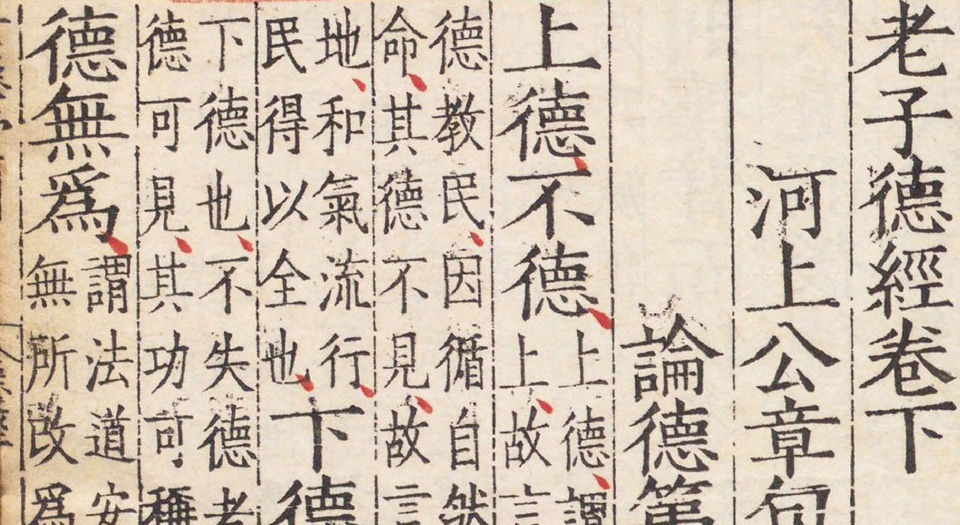
Lao Zi (lit. Old Master) is regarded in Chinese culture as the founding father of Daoism and author of one of the most translated books in the world: Dao De Jing. Another shortened name for the Dao De Jing is the Laozi or ‘The book of five thousand characters. According to legend, Lao Zi was born in the 5th century BC, a time companion of Kong Zi (Confucius), the Greek philosophers Socrates and Plato and Shakyamuni Buddha in India. Famous are the first lines of Dao De Jing: ‘The eternal Dao can’t be expressed in words. The eternal name cannot be named.’
Originally, the name Dao means ‘way’. Crucial in the Laozi is its focus on ziran which means ‘spontaneity’, or: ‘what naturally is as it is’. This is Dao. There is nothing to follow, not even the Dao, as everyone already ‘has’ Dao. Another key concept is wei wu wei which can be translated as ‘do without doing.’ It is like the seeds in the soil that sprout during spring and fructify in the summer, falling in the autumn and store in the soil in the winter. In modern terms: relax, connect with your inner self, and go with the flow.
Zhuang Zi
The Zhuangzi belongs to the oldest Daoist texts. It was written in the 4th century BC and the main author was Zhuang Zi or Zhuang Zhou. The book is un-Chinese for his time in the sense that Zhuang Zi describes stories about the ‘normal people’ like farmers and craftsmen. But also, the tone is unique as Zhuang Zi uses an unusual combination of satire and humor. He was a man who cherished his own freedom and independency and like many other Daoists refused to take up official positions. “Zhuangzi was once fishing beside the Pu River when two emissaries brought him a message from the King of Chu: “The king would like to trouble you with the control of his realm.” Zhuangzi, holding fast to to his fishing pole, without so much as turning his head, said: “I have heard there is a sacred turtle in Chu, already dead for threethousand years, which the king keeps in a bamboo chest high in his shrine. Do you think this turtle would prefer to be dead and having his carcass exalted, or alive and dragging his tail through the mud?” The emissaries said: “Alive and dragging his tail through the mud.” Zhuangzi said, “Away with you then! I too will drag my tail through the mud!”
Zhuang Zi was a follower of Lao Zi and calls him in his book ‘Old Master’ or Lao Dan. He tells many stories about Lao Zi and the confrontation between him and Kong Zi, where the latter expresses his gratitude to him. Zhuang Zi in his writings focuses on free thinking and broad knowledge like the Dao, instead of rigidity and small thinking which he saw in Kong Zi and his followers.
Lie Zi
The third and youngest book in the Daoist canon is the Lie Zi. The figure Lie Zi – his full name would have been Lie Yukou – is being mentioned in the first chapter of the Zhuangzi. There he is mentioned as a Daoist with magical powers who could ride the clouds. According to historian Huangfu Mi was Lie Yukou his whole life a hermit. Like Zhuangzi and other Daoists in Chinese history he refused to hold an official position. The stories in the Liezi give insight in how to live according to the Dao. “My body is in harmony with my spirit, my spirit is in harmony with my qi, my qi is in harmony with my heart, and my spirit is in harmony with Nothing. [..] I don’t know if I know with my sense organs and my four limbs, or that I know via my heart, my belly and my organs: it is knowledge that comes naturally.”
Confucius
The Eastern Zhou period (770 – 256 BC) was characterized by many wars where local lords were striving for hegemony. Wise men who could advise rulers how to behave and how to rule their country were becoming more and more high in demand. One of these men was Confucius (551 – 479 BC). Born in Lu in Shandong Province, he traveled with his disciples to different states hoping to find rulers who were open to his advice. In many cases he saw exactly the opposite of what he aimed for: greed, ignorance and irresponsibility. Confucius can be seen as China’s first moral philosopher as he wanted to inspire people to do good. He linked moral behavior to traditional roles and believed that in the old times – the beginning of the Zhou dynasty – everyone knew his place in society and this hierarchy lead to harmonious coordination. Filial piety – the deep respect from children towards their parents – was crucial in his philosophy and has deeply influenced Chinese culture till today. The highest virtue for Confucius was ren, which can be seen as benevolence, humanity and nobility. Cofucianism, together with Daoism and Buddhism, are being seen as the three great pillars of Chinese culture.
Buddhism
From the second century onwards buddhism spread via the trading routes from northern India to China. At the end of the Western Jin dynasty (265 – 316) the higher classes of Chinese society were drawn to this new philosophy which had so much in common with Chinese native Daoism. The notion in Buddhism that everyone is equal and has inherently already buddha nature – independent of background, race, sex – lead to popularity among alien rulers in China. With buddhism as backbone they were more able to unify an ethnically mixed population, which under Confucian rules was unthinkable. The wide attraction to Buddhism among common people was the fact that it addressed the notion of suffering and death, and the way how to release from suffering, issues that were new in Chinese philosophy. The rise of buddhism – illustrated by the building of thousands of temples all over the country – led to jalousy among Daoism and Confucianism. It was especially the fact that monasteries were not obliged to pay taxes and that they owned lots of land so that the monasteries were able to enrich themselves. This in turn created tensions and led to persecutions of Buddhism. Nevertheless, Buddhism and its different schools had an enormous influence on Chinese culture and thinking.
Bodhidharma
According legend it was the Indian monk Bodhidharma (in Chinese: Damo) who brought Buddhism around the 5th-6th century to China. Famous in zen stories is that the first nine years in China he was sitting in deep meditation facing the wall. ‘Wall gazing’, like he practiced, is being regarded as zazen, sitting silently in meditation. Also famous is the encounter between Bodhidharma and the Emperor Wu of Liang, who was a fervent patron of Buddhism. He was proud of his work of building a lot of temples and ordaining Buddhist monks. And he was curious about the merits for his deeds. Bodhidharma replied: “None. Good deeds done with worldly intent bring good karma, but no merit.”
Emperor Wu said: “So what is the highest meaning of noble truth?” Bodhidharma replied: “There is no noble truth, there is only emptiness.” Emperor Wu: “Then, who is standing before me?”
Bodhidharma: “I know not, Your Majesty.”
Six Patriarchs of Zen
Bodhidharma was the the first of the six patriarchs in Chinese chan (or zen) buddhism. Huineng (638 – 713) was the last one in the lineage and is a key figure in the history of Chinese chan buddhism. Illiterate and from a poor background, he attained awakening upon hearing the Diamond Sutra. Huineng was the founder of the Sudden Enlightenment Southern School of Buddhism. Later in history Buddhism split in a Northern and Southern School. But Buddhism kept its deep influence on Chinese culture.